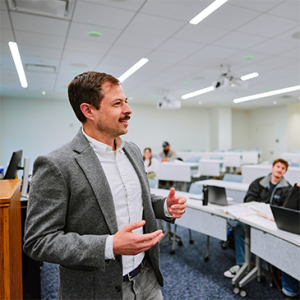
Kristen Cain joined Maine Law’s Refugee and Human Rights Clinic (RHRC) in August as the Sally L. Stevens Immigration Law Fellow and Staff Attorney, bringing a background in immigration advocacy, human rights, teaching, and community-based legal work to the role.

Originally from the Poughkeepsie area of New York, Cain earned her B.A. in international studies from Fordham University. Her interest in working with immigrant communities began while studying abroad in Morocco, where she taught English to adults taking continuing education courses for their careers. After graduation, she continued teaching before serving as an AmeriCorps member with The Right to Immigration Institute in Boston, assisting noncitizens with applications for asylum and other forms of humanitarian relief.
By the time Cain entered Boston University School of Law, she knew she wanted to pursue immigration law. Her experiences there, however, broadened her understanding of the field.
“Before I came to law school, I really only knew about one aspect of immigration law, which was asylum law,” Cain said. “It opened my eyes to how many problems there are with the system and how the system is set up for people, especially those without representation, to fail.”
At BU, Cain was deeply involved in clinical and community-based advocacy. Through the International Human Rights Clinic, she worked on issues involving human rights abuses at the U.S.-Mexico border. Her work with the Immigrants’ Rights Clinic included advocating for clients seeking release from immigration detention and relief from removal. She also organized detention visits, volunteer opportunities, and trainings designed to help other law students become involved in advocacy.
Cain gained additional experience with Harvard’s Immigration and Refugee Clinical Program, the Northwest Immigrant Rights Project, and the Political Asylum/Immigration Representation Project before earning her J.D. in May 2026.
Those experiences also helped Cain recognize that clinical education offered a way to bring together two longstanding interests.
“I really like teaching, and in law school I was working with law students a lot as well,” she said. “I liked the idea of being able to combine my love of teaching and immigration.”
That combination is central to the RHRC’s work. Since its founding in 2012, the Clinic has paired direct client representation with community-driven outreach and legal education. Student attorneys provide rights presentations and workshops in schools, adult education programs, healthcare settings, and other community spaces, while also training educators, healthcare providers, attorneys, and community organizations that work with Maine’s immigrant communities.
As the immigration landscape evolves, the Clinic works with community partners to respond to emerging needs through direct representation, limited-scope assistance, public education, and broader advocacy. Cain’s background in teaching students and community-based immigration work closely aligns with that approach.
At Maine Law, Cain represents RHRC clients in immigration matters and contributes to the Clinic’s projects and litigation. She is also helping develop efforts focused on immigration detention, including collaborating with other organizations to support advocacy for people detained in Maine and Maine residents transferred to facilities elsewhere.
For Cain, the challenges facing immigrant communities have also underscored the importance of building a broader network of people equipped and willing to help. She has been encouraged by the interest she has already seen among Maine Law students.
“Coming here and seeing all the students who want to get involved as well is inspiring,” Cain said.